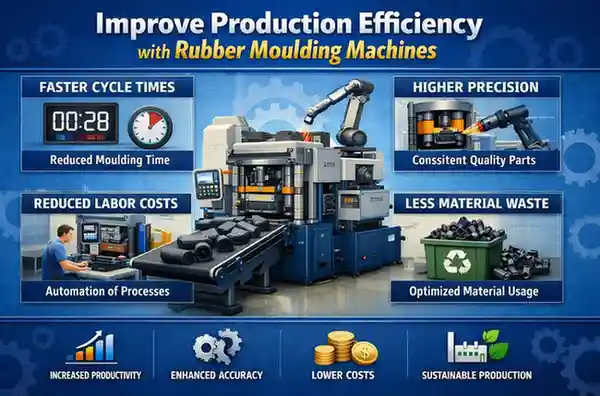
Improve Production Efficiency with Rubber Moulding Machines
Improve Production Efficiency with Rubber Moulding Machines
In today’s competitive manufacturing environment, improving production efficiency while reducing operational costs is a top priority for industries worldwide. One of the most effective solutions is the adoption of rubber moulding machines, which are transforming how rubber products are manufactured.
This comprehensive guide explores how rubber production automation enhances productivity, reduces waste, and delivers high ROI. Whether you operate in automotive, construction, or industrial manufacturing, understanding these systems can significantly improve your operations.
What Are Rubber Moulding Machines?
Rubber moulding machines are industrial systems used to shape rubber materials into specific forms using heat and pressure. These machines are widely used for producing durable and high-performance components.
Why Production Efficiency Matters
Efficiency in manufacturing directly impacts profitability, scalability, and competitiveness.
- Reduces production time
- Minimizes material waste
- Improves product quality
- Lowers operational costs
How Rubber Moulding Machines Improve Efficiency
1. Automation of Production Processes
Modern machines integrate industrial productivity machines features like automated loading, curing, and unloading.
2. High-Speed Production
Advanced systems significantly increase output compared to manual methods.
3. Precision and Consistency
Ensures uniform product quality with minimal defects.
4. Reduced Labor Dependency
Automation reduces reliance on manual labor and human error.
5. Energy Efficiency
Modern machines are designed to optimize energy consumption.
Types of Rubber Moulding Machines for Efficiency
Compression Moulding Machines
Ideal for producing strong and durable components with minimal waste.
Injection Moulding Machines
Best suited for high-speed and high-volume production.
Transfer Moulding Machines
Used for complex parts requiring precision.
Automated Moulding Systems
Fully integrated systems designed for maximum productivity.
Cost Savings with Rubber Production Automation
Implementing manufacturing optimization strategies leads to significant cost savings.
| Cost Factor | Before Automation | After Automation |
|---|---|---|
| Labor Costs | High | Reduced by 30-50% |
| Material Waste | 10-15% | 3-5% |
| Production Time | Long | Optimized |
ROI of Rubber Moulding Machines
Investing in moulding efficiency tools delivers measurable ROI.
| Metric | Traditional Setup | Automated Setup |
|---|---|---|
| Production Output | 100 Units | 160-220 Units |
| Defect Rate | 8% | 2% |
| Operational Cost | High | Optimized |
Applications Across Industries
Automotive Industry
Manufactures seals, gaskets, and vibration control components.
Construction Industry
Produces insulation and structural rubber parts.
Electronics Industry
Used for protective components and seals.
Consumer Goods
Applications include footwear and appliances.
Smart Manufacturing Integration
Modern industrial productivity machines integrate with smart technologies:
- IoT-enabled monitoring
- AI-based quality control
- Predictive maintenance
- Cloud-based analytics
Key Factors for Maximizing Efficiency
- Choose the right machine type
- Optimize production workflow
- Train workforce on automation systems
- Implement preventive maintenance
Common Challenges and Solutions
Challenge: High Initial Investment
Solution: Focus on long-term ROI and cost savings.
Challenge: Integration Complexity
Solution: Work with experienced suppliers.
Challenge: Maintenance Requirements
Solution: Implement predictive maintenance strategies.
Future Trends in Rubber Manufacturing
- Fully automated production lines
- Energy-efficient machines
- AI-driven process optimization
- Sustainable manufacturing practices
Expert Tips for Manufacturers
- Invest in scalable automation systems
- Focus on reducing waste and downtime
- Choose high-quality equipment
- Continuously monitor performance metrics
Conclusion
Rubber moulding machines are a powerful solution for improving production efficiency and reducing manufacturing costs. By leveraging rubber production automation, businesses can achieve higher output, better quality, and significant cost savings.
As industries move toward smart manufacturing, adopting advanced industrial productivity machines will be essential for staying competitive in the global market.
Ready to optimize your production line? Investing in modern moulding efficiency tools is the key to sustainable growth and profitability.